The best pet for you isn't always the cutest one or the breed you've always wanted. Your lifestyle, home, available time, budget and ability to provide daily care should all influence your choice.
Isapet Veterinary Clinic team · 24 September 2026

The right pet isn't about the breed you've always wanted — it's about the one that fits the life you actually live.
Before bringing an animal home, think about what its everyday needs will mean for you and your family.
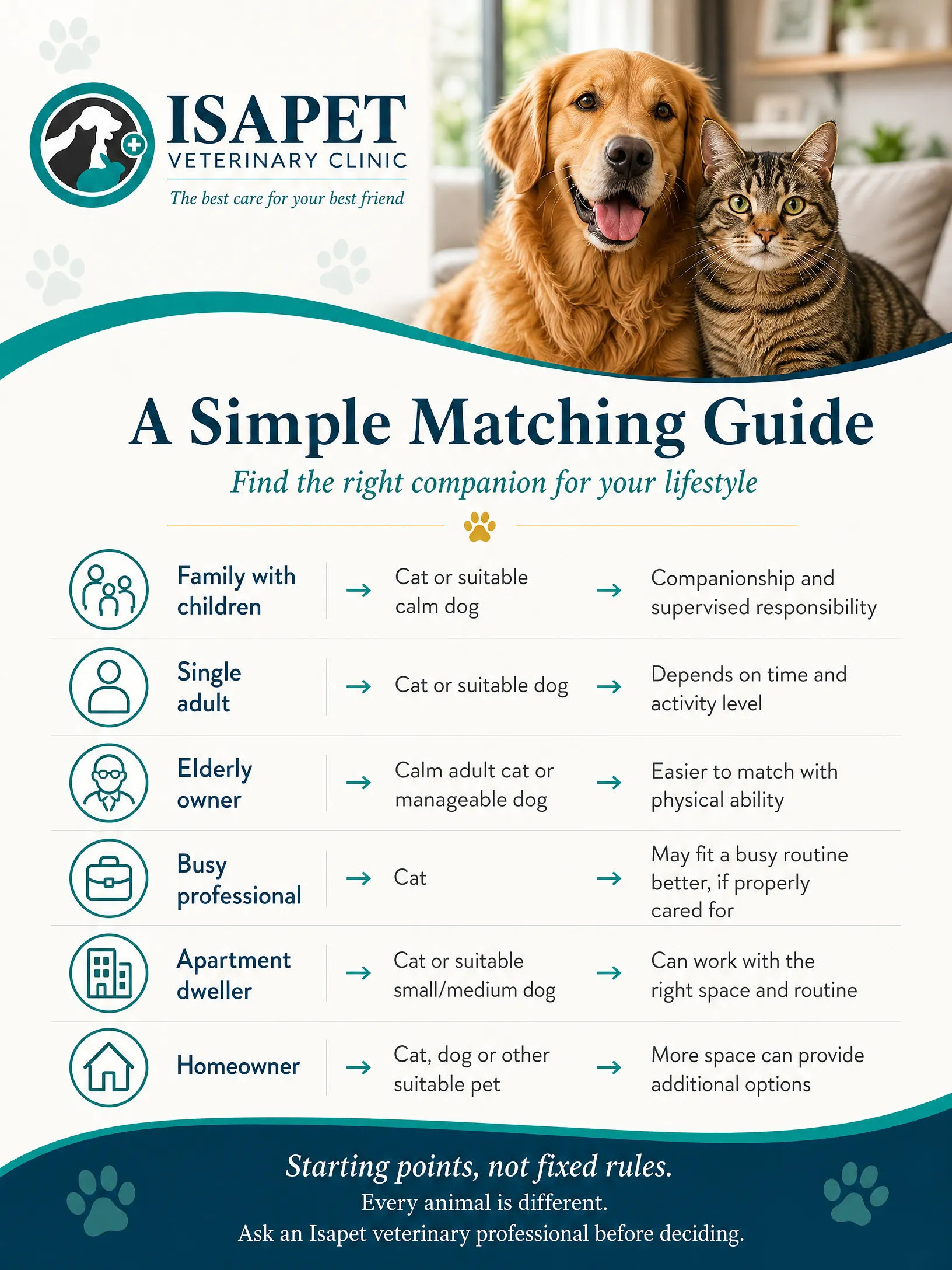
Every household is different. A family with children may need a different pet from a busy professional living alone. Someone in an apartment may also have different options from someone with a secure compound.
There's no single "best pet." The better question is: which pet can I realistically care for well? Here are some common situations to consider.
A good starting choice: A well-supervised cat or a suitable, calm dog
Children can learn empathy and responsibility from caring for animals, but the adults in the home remain responsible for the pet.
A cat can be a good option for families looking for an animal that doesn't require daily outdoor walks. Children can help with age-appropriate tasks such as supervised feeding, gentle play and keeping the pet's area tidy.
A dog can also be a wonderful family companion, especially where adults have enough time to supervise the children and provide the dog's exercise, training and veterinary care.
The key consideration isn't simply choosing a "child-friendly" breed. The child's age, the individual animal's temperament and the family's ability to supervise interactions all matter.
Best fit: A family that can teach children how to handle animals gently while adults remain responsible for daily care.

Children can learn empathy from a pet — but the daily care still rests with the adults in the home.
A good starting choice: A cat or a dog that matches your routine
Living alone doesn't mean you can't have a pet. It does mean you need to think carefully about your daily schedule.
A cat may suit someone who wants companionship but has limited opportunity for outdoor activities. You'll still need to provide regular feeding, litter care, play, veterinary attention and a safe home.
A dog may be a better fit if you enjoy an active routine and can make time for exercise, training and companionship every day.
If your work regularly keeps you away from home for long hours, consider who will care for your pet when you're unavailable.
Best fit: A pet whose daily care requirements match the amount of time you can reliably give.
A good starting choice: A calm adult cat or a manageable small-to-medium dog
For older adults, companionship can be an important part of having a pet. But physical ability and daily routine should be considered before choosing an animal.
An adult cat may be easier to manage than a young, energetic kitten because its personality and activity level are already more established.
A calm, manageable dog can also be suitable, particularly if the owner can comfortably handle feeding, cleaning, exercise and veterinary visits.
A very energetic puppy or large dog may create additional physical demands — walking and controlling a strong dog can become difficult if the owner has limited mobility.
Best fit: A calm animal whose size, strength and activity level the owner can comfortably manage.

A calm, manageable pet matches an owner's routine and mobility just as much as their companionship needs.
A good starting choice: A cat, provided its needs can still be met
A demanding job doesn't automatically rule out pet ownership. However, your schedule needs an honest assessment.
Cats may fit some busy households because they generally don't need to be taken outside for daily walks. They still require regular feeding, clean water, litter care, attention, play and veterinary care.
Dogs can also suit busy professionals, but they usually require more direct involvement. Exercise, training, companionship and bathroom routines need to be planned into the day.
If you regularly work long hours, travel or spend nights away from home, make a reliable care plan before getting a pet.
Best fit: A pet that fits your actual schedule — not the schedule you hope to have.
A good starting choice: A cat or a suitably matched small dog
Apartment living doesn't automatically mean you can't own a pet.
Cats can often adapt well to indoor living when their basic needs are properly provided — safe spaces to rest, suitable opportunities for play and mental stimulation, clean litter facilities and regular care.
Dogs can also live comfortably in apartments, but size isn't the only consideration. Energy level, temperament, exercise needs and your ability to provide regular activity matter just as much.
A small dog is not automatically a low-maintenance dog. A Chihuahua, for example, is small but still needs attention, training, exercise and veterinary care.
Also check your building's rules before bringing an animal home.
Best fit: A pet whose size, activity level and behaviour can comfortably fit your living space and routine.

Size isn't the only apartment consideration — energy level and temperament matter just as much.
A good starting choice: A dog, cat or other suitable pet
Having a larger home or compound gives you more space, but it doesn't remove the responsibilities of pet ownership.
A dog may benefit from secure outdoor space for activity, but a yard is not a substitute for exercise, interaction and training. You still need to spend time with your dog.
Cats can also thrive in houses and compounds, provided they have a safe environment and appropriate care.
For homeowners considering a larger dog, think carefully about the animal's adult size, exercise needs and temperament. A German Shepherd, for example, may have very different space and activity requirements from a small Chihuahua.
And what about "Bosco" — the familiar mixed-breed dog found in many Kenyan homes? A local mixed-breed dog can be a good companion, but don't assume every Bosco has the same characteristics. Their size, behaviour and needs can vary considerably. Assess the individual animal rather than choosing based only on a name or appearance.
Best fit: A pet whose needs match the space available and the time you can provide.

A yard isn't a substitute for exercise, interaction and training — space alone doesn't meet a pet's needs.
Breed, size and appearance can influence your decision, but they shouldn't be the only factors. Before choosing a pet, consider:
Remember that these are starting points, not fixed rules. Individual animals differ, and a veterinary professional can help you think through the needs of a particular pet before you make a decision.
Ask yourself:
Choosing the right pet starts with understanding your own lifestyle. The perfect pet isn't necessarily the most expensive breed, the smallest dog or the animal that looks best in a photograph — it's the animal whose needs you can consistently meet with your available time, space, money and attention.
If you're unsure which pet would suit your household, speak to a veterinarian before making the commitment. A little planning can help you choose responsibly and give your new companion the care it deserves.
